Stop Hunting for Your Omnichannel Performance Data
Your data is everywhere — except where you need it.
If you're running an omnichannel retail business in Asia, you probably feel this pain every week:
You're staring at dashboards from POS, e-commerce, media reports, marketplace panels, ERP exports, and that random Google Sheet someone built three years ago… Yet somehow, you still can't answer a simple question like: "Why did sell-through dip last week?"
You have the data. You have the dashboards. But the answers? They never show up on time.
In late 2025, this problem has only grown bigger. Retailers have more channels, more products, more data sources… and somehow less clarity.
As one of the insights from McKinsey in 2024 put it: retail today is rich in data but poor in insight. And yet, most analytics teams spend more time preparing data than using it.
This is why 2026 planning is different. This is the year retail leaders stop asking for more dashboards — and start asking for fewer blind spots.
The Real Problem
Retail KPIs are not hard. Getting them aligned, unified, and trusted is.
Most retailers know their top metrics: sales, traffic, inventory, margins. But omnichannel operators have a more dangerous problem:
The same KPI shows different values across different systems.

And during your monthly business review, everyone debates whose number is correct instead of what decision to make next. This is the problem ReOrc solves on the semantic layer and unified KPIs. But before we get into solutions, here's what you — the retail leader planning for 2026 — really need to know.
The Planning Reset
Across the hundreds of conversations and data foundations we have built for global and Asian retailers, these are the KPIs that consistently move the needle.
1. Real-Time Sell-Through Rate (STR)
Why it matters: STR is the single clearest indicator of demand, assortment health, and merchandising effectiveness across channels.
The 2026 upgrade:
- STR unified across POS, web stores, marketplaces
- STR segmented by region, category, and SKU clusters
- STR mapped against availability (OOS rate) and content readiness
Most retailers still calculate STR weekly.
Leaders in 2026 will monitor STR continuously, with AI alerts if performance deviates from expected patterns.
2. On-Shelf Availability (OSA) — Offline + Online
Omnichannel retailers have two availability problems:
- Physical stockouts
- Digital stockouts: item exists but is not discoverable, lacks updated content, or isn't visible due to ranking penalties
OSA 2026 KPI Stack:
- OOS %
- Back-in-stock cycle time
- Digital availability: listing health, keyword coverage, and content completeness
- Buy-box win rate (marketplaces)
3. Inventory Productivity KPIs
Inventory has become the battlefield of omnichannel profitability. Key KPIs for 2026:
- Weeks of Supply (WOS)
- Aged Inventory %
- Dead Stock Ratio
- Inventory Turnover (GMROI)
- Return-to-stock cycle time
McKinsey notes that by using AI to optimize replenishment & forecasting, retailers can achieve up to 30% inventory reduction without impacting sales. Companies like Zara and Walmart have successfully implemented AI in their inventory management systems, leveraging these benefits to maintain a competitive edge and improve operational efficiency.
4. Campaign Efficiency & Incremental ROAS
Instead of isolated channel metrics, 2026 retailers need:
- Incremental ROAS
- CAC per channel, blended CAC
- Marketing-to-stock alignment score
- Promo-to-margin ratio
- Campaign-based OOS impact
Marketing performance must be tied directly to availability, demand signals, and inventory status — not siloed ROAS reports.
5. Customer KPIs That Predict Lifetime Value
Omnichannel retailers who unify customer profiles across channels unlock higher LTV. Critical KPIs:
- Repeat purchase rate
- Frequency uplift between channels
- Cross-channel migration (offline → online → loyalty app → marketplace)
- Early churn signals
- NPS segmented by channel
Why do you still not have this data today?
Across the retail clients ReOrc has supported — from Mars to Subway to omnichannel lifestyle brands — the problem is rarely lack of data. It's how scattered the data is. These are the 5 most common reasons leaders still don't get trusted omnichannel KPIs:
- Each team builds its own version of truth.
- Systems don't speak the same "data language."
- No semantic layer = no unified KPI definitions
- Too many data sources, too few connectors
- Retail teams rely on people, not machines
The Turning Point
AI-Native Retail Intelligence (Finally) Fixes This.
In 2025, something quietly shifted. AI-native data systems — not retrofitted add-ons — started replacing traditional BI. ReOrc is one of the few players in Asia building this from the ground up. What does "AI-native" mean for retail KPIs?
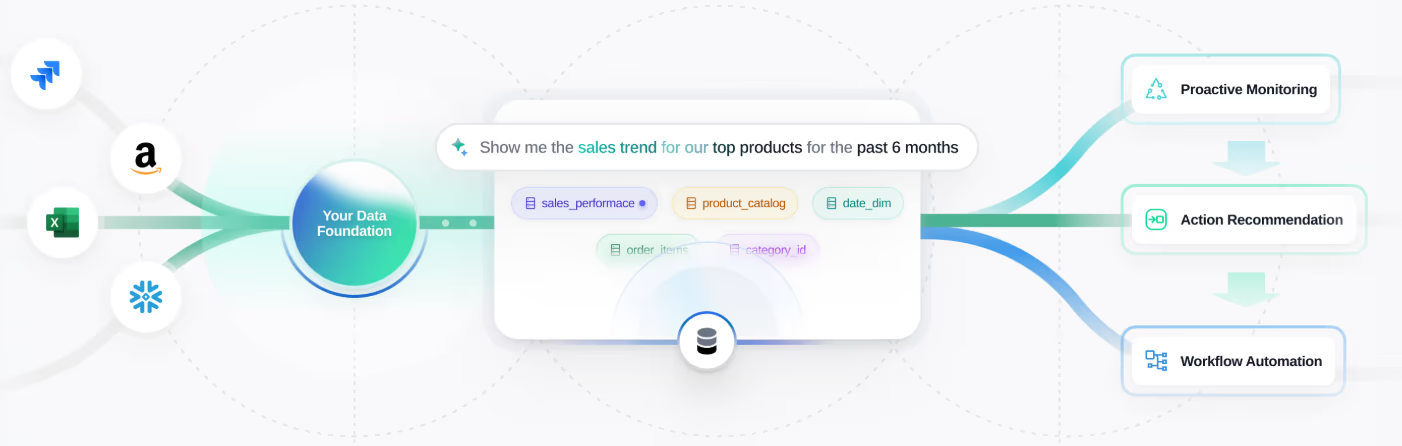
1. KPIs are defined once, trusted everywhere
ReOrc's semantic layer ensures every team uses the same formula, same logic, same data. Your Monday meeting stops being a debate club.
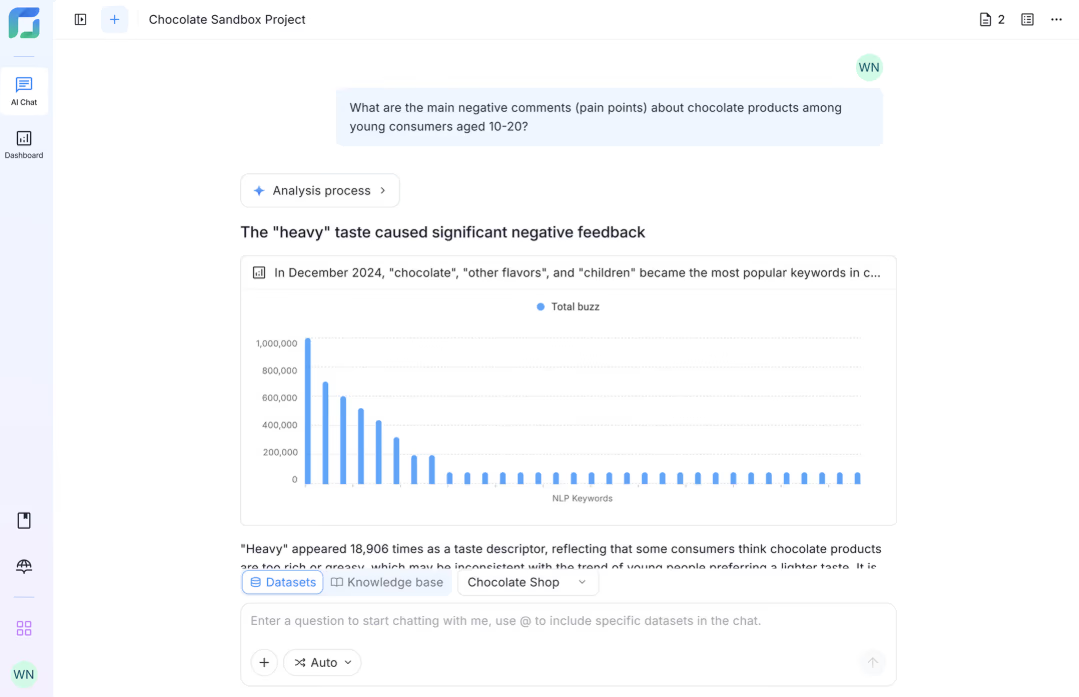
2. You ask questions in plain English
And the AI data agent returns:
- answers
- charts
- explanations
- anomalies
- root-cause insights
Not SQL queries. Not endless filters.
3. Inventory KPIs update automatically
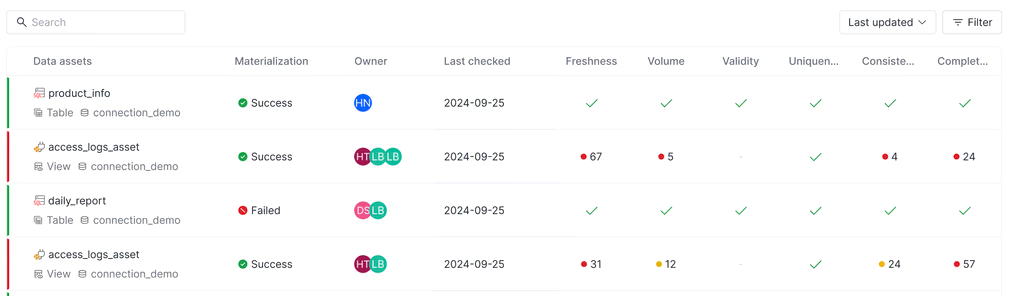
WOS, STR, OSA, aging… all updated as often as your data refreshes — no manual work.
4. AI spots issues before they become losses
A store STR anomaly? A category OOS spike? A campaign running despite inventory shortfall?
You get alerts — not surprises.
5. Workflow automation closes the loop
Low inventory? → Auto-generate replenishment workflow.
Key SKU mispriced? → Send to merch team.
Campaign out of sync? → Notify marketing.
This is part of the ReOrc AI agents.
The future of retail isn't more data - it's less hunting
In 2026, the winners will be the retailers who: unify their data → trust their KPIs → act faster with AI.
ReOrc is already powering this shift for global operators — from Mars to Subway — by building AI-native data foundations, semantic layers, and multi-agent intelligence that remove manual work and unlock real omnichannel visibility.
If you're planning your KPI for 2026, this is the moment to stop hunting for data — and start leading with AI-native intelligence.