Your people decide. AI employees do the legwork.
We design, build and run teams of AI employees that work alongside your people, in any industry and any department: sales, customer operations, supply chain, marketing, project delivery or finance. Each one has a clear role and works inside the tools you already use. Your team sets the priorities, reviews the output and approves anything that matters, and every step stays visible, so you always know who did what, and why.
Most companies have AI. Few have AI doing the work.
A licence for everyone is not a transformation. The work still runs the way it did, one person and one prompt at a time.
Each person asks the tool in their own way. Nothing is repeatable, so the process never gets faster.
An answer nobody checked is an answer nobody trusts, so the work gets redone by hand.
How the work really gets done leaves with the person who did it.
Hours saved, errors avoided, adoption by team: without numbers, the programme stalls after the pilot.
Staff a role, not a software project
Pick the repetitive role that eats the most hours. We staff it with an AI employee, a named person on your team approves what matters, and you pay as you go for the work it actually does.
Order desk assistant
- Takes orders from marketplaces, chat and email
- Enters them in your system, with stock and price checked
- Flags anything unusual before it ships
Customer follow-up officer
- Answers routine customer questions
- Follows up after every delivery
- Handles returns and warranty requests
Collections assistant
- Sends payment reminders on schedule
- Matches incoming payments to invoices
- Prepares a weekly overdue list and escalates disputes
Sales researcher
- Finds and qualifies leads that fit your customer profile
- Keeps the CRM current after every conversation
- Drafts first outreach and quotes from your price list
Supplier and shipment tracker
- Chases supplier confirmations and updates purchase orders
- Tracks shipments across carriers
- Warns early when a delivery is about to slip
Report builder
- Pulls numbers from your systems every week
- Builds the weekly and monthly reports you already use
- Highlights what changed and why
Every role comes with a written job description, a named approver on your team and a monthly impact report. It takes the repetitive load off your people; it does not replace them.
Tell us which role to start withWe run our own firm this way
AI employees and people work side by side in ReOrc's own operations every day. These are the numbers we hold ourselves to.
of routine work handled by AI employees
AI employees on duty, around the clock
of decisions that matter made by a person
actions without a record
What we build for you
Four things every engagement delivers, whatever your industry. Together they turn AI from a tool people try into work that gets done.
AI employees with a clear role
Each one starts like a new hire: a role, a scope, the tools it may use and a named person it reports to. It picks up work as soon as it arrives and sees it through.
Four stages, one workflow at a time
We start where the hours are obvious and prove it before we widen the scope.
Map
Two weeks alongside your team: we shadow the work, count the hours and pick the first workflow worth handing to AI employees.
Build
Roles for the AI employees, the shared desk, the playbooks and the connections to your tools. Your people learn the desk, not new software.
Run
We manage the AI employees with you: weekly tuning, corrections turned into rules, and the first monthly report.
Widen or hand over
Add the next workflow where the numbers say so. Keep us running it as a managed service, or take it in-house with the playbooks.
Any industry, any team with repeatable work
If the work is frequent, follows rules and currently eats hours of someone who has better things to do, AI employees can take it on.
Retail and e-commerce
Orders across marketplaces, stock and price checks, returns, and supplier follow-ups before a shelf runs empty.
Manufacturing and supply chain
Purchase orders, supplier confirmations, shipment tracking and early warnings when a delivery slips.
Sales and marketing
Lead research and qualification, CRM updates, quotes from your price lists and a weekly pipeline and campaign report.
Customer service
Tickets, bookings, returns and after-sales follow-up, with VelaCX on the front line and your rules behind it.
Professional services and projects
Proposals and contract drafts, project status updates, timesheet chasing and client reporting.
Finance and administration
Invoices, approvals, expense claims and the monthly management pack, prepared for your team to review.
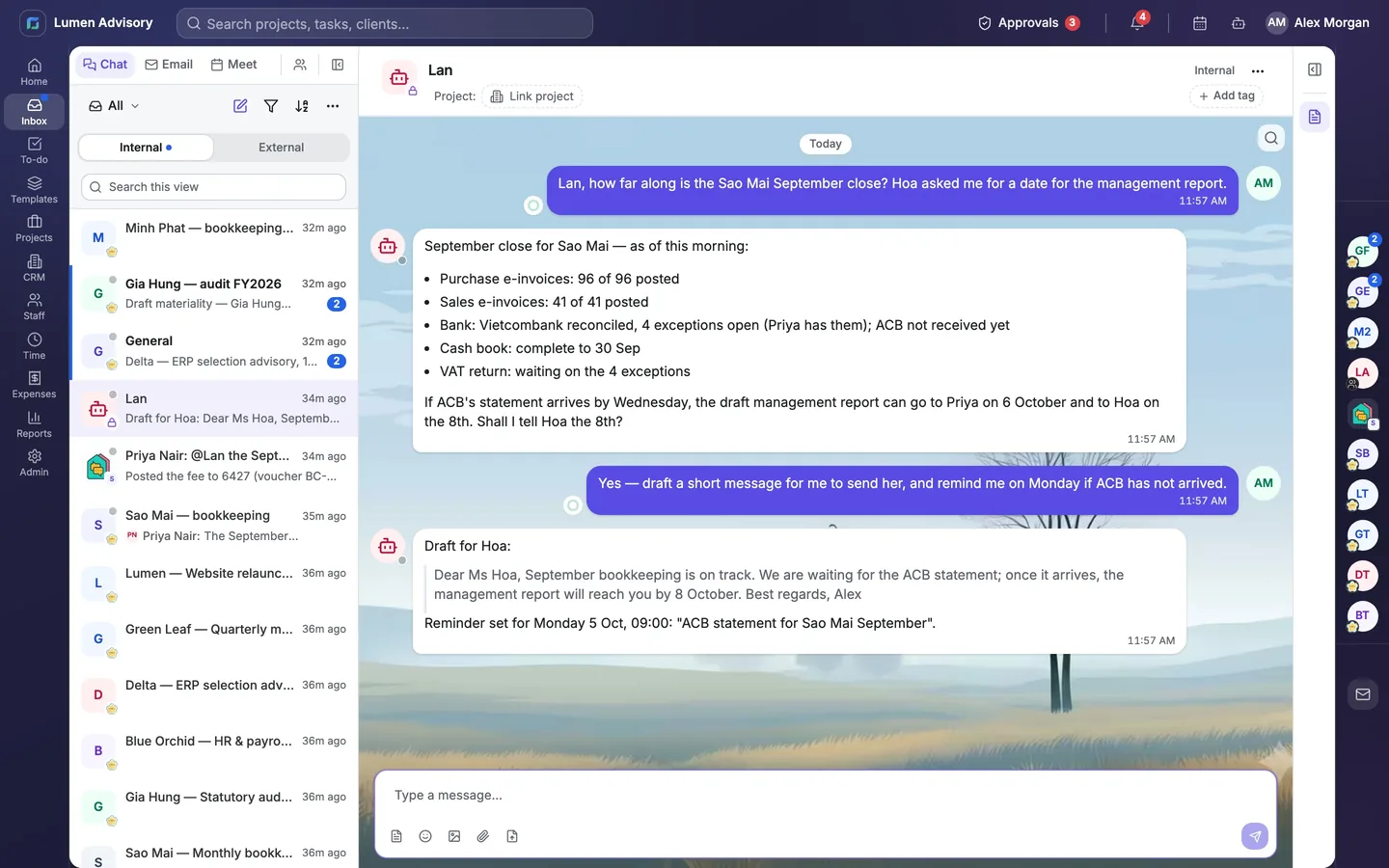
A day with your AI employees
We built this way of working into Practica, the platform our own firm runs on every day: AI employees with clear roles, people signing off on what matters, every step on record. AI Transformation brings it to your team, whatever your industry.
Explore the technology →Chat tools, automation projects, or AI employees you can hold to account?
Three ways companies try to get value from AI, and where each one stops.
| Criteria | A chat tool per person | An automation project | ReOrc AI employees |
|---|---|---|---|
| What it does | Answers questions for one person | Scripts one fixed workflow | Does whole jobs, end to end, inside your tools |
| When a case is unusual | The person guesses | It breaks, or waits for the vendor | Goes to the right person with the context |
| Who is accountable | Nobody | The vendor, for a while | A named person on every decision that matters |
| Knowledge | Stays in personal chats | Locked inside the script | Playbooks you own, updated by every decision |
| Measurement | Anecdotes | A project report at the end | A monthly impact report: hours, exceptions, adoption |
| Pricing model | Per seat | Per project, then change requests | Pay as you go, for the work actually done |
Why ReOrc
We run one ourselves
Our own firm works this way every day, with AI employees and people on the same work. We know what breaks, and what it takes to make it stick.
Built for accountable work
We come from regulated work, where every decision needs an owner and a record. Approvals, a full activity log and a person on every consequential decision are the default, not an add-on.
Works in your tools
AI employees use your CRM, ERP, spreadsheets, email and chat. Your team learns one shared desk, not a new system.
A service, not a licence
We build it, run it with you and report on it, and you pay as you go for the work it does. No per-seat pricing, no pilot that never ends.
Start where the hours are obvious
No company-wide programme. We pick one workflow where the hours are visible, run it with your team from the first week and let the monthly report decide what comes next.
Talk to us about your operations →Frequently asked questions
Is this only for finance or accounting teams?
No. The model works in any industry and any team with frequent, rule-based work: sales, customer service, operations, supply chain, marketing, project delivery, finance or HR. We start with the workflow that eats the most hours in your business, whatever it is.
Do we need new software?
No. AI employees work inside the tools you already use: your CRM, ERP, spreadsheets, email, chat and industry systems. Your team learns one thing, the shared desk where reviews and approvals happen.
Can I integrate Practica with any third-party software or web app?
Yes. If your software or web app has an API, we connect to it directly; if it does not, we build the connection during the Build stage, using webhooks, email or file exports. There is nothing for your IT team to develop.
What happens when an AI employee gets something wrong?
Anything outside its remit goes to a person before it has an effect, and anything that spends money, signs, sends or publishes waits for approval. If a mistake does slip through, the activity log shows exactly what happened, and the correction becomes a rule so it does not repeat.
Who owns the AI employees, the rules and the data?
You do. The playbooks are written for your business and stay with you, and your data is isolated per client with role-based access. We never use it to train models for anyone else.
How do we know it is working?
Every month you get an impact report: hours returned per workflow, exception rate, turnaround time and how each team is working with its AI employees, plus our recommendation for the next workflow. If the numbers do not move, we say so.
What does it cost?
Pay as you go. Each month you pay for the work your AI employees actually did, with the shared desk and the monthly report included. No per-seat licences. The Map stage is priced on its own, so you can stop after it.
Talk to us about your operations
Tell us which workflow eats the most hours today. We reply within one business day.